Part ofIndia IT Cost·Pricing guides for IT services in India — websites, mobile apps, e-commerce, custom software, and GST billing systems.
You spent money building a great website, but without regular maintenance, it starts breaking down. Security vulnerabilities pile up, plugins go outdated, loading speed drops, and your Google rankings slide. In India, website maintenance costs range from ₹1,500 to ₹15,000+ per month depending on what's included.
This guide breaks down exactly what website maintenance costs in India in 2026, what each package tier includes, and how to decide what your business actually needs.
What is Website Maintenance?
Website maintenance includes everything required to keep your website secure, fast, and up-to-date after launch. Think of it like servicing a car. You don't just buy it and forget about it. Regular maintenance prevents small issues from becoming expensive problems.
Need Help With Your Project?
Tell us what you're building — we'll send a detailed proposal with timeline and cost breakdown within 24 hours.
Key maintenance activities include:
- Security updates — patching CMS, plugins, and framework vulnerabilities
- Backup management — automated daily/weekly backups with restore capability
- Performance monitoring — tracking page speed, uptime, and Core Web Vitals
- Content updates — changing text, images, prices, or adding new pages
- SSL certificate renewal — ensuring HTTPS stays active
- Bug fixes — resolving display issues, broken links, and form errors
- SEO monitoring — tracking keyword rankings and fixing technical SEO issues
How Much Does Website Maintenance Cost in India in 2026?
Basic Maintenance: ₹1,500–₹3,000/month
Best for: Personal websites, portfolios, and single-page landing pages.
- Monthly security patches and CMS updates
- Weekly automated backups
- Uptime monitoring (99.5% SLA)
- SSL certificate management
- Up to 2 content changes per month
- Basic email support (48-hour response)
Standard Maintenance: ₹3,000–₹7,000/month
Best for: Business websites, service company sites, and blogs with regular content updates.
- Everything in Basic, plus:
- Weekly security scans and malware removal
- Daily automated backups
- Performance optimization (page speed tuning)
- Up to 5 content changes per month
- Monthly analytics report
- Priority email + phone support (24-hour response)
- Plugin/dependency updates and compatibility checks
Premium Maintenance: ₹7,000–₹15,000/month
Best for: E-commerce stores, web applications, SaaS products, and high-traffic sites.
- Everything in Standard, plus:
- Real-time security monitoring and firewall management
- Hourly backups with instant restore
- High-volume content changes (defined fair-use quota)
- A/B testing support
- Monthly SEO audit and recommendations
- Core Web Vitals optimization
- Database optimization and cleanup
- Same-day emergency support
- Staging environment for testing changes
Enterprise / Custom: ₹15,000+/month
Best for: Multi-site businesses, complex web applications with custom integrations, and companies requiring dedicated support.
Need Help With Your Project?
Tell us what you're building — we'll send a detailed proposal with timeline and cost breakdown within 24 hours.
- Dedicated account manager
- Custom SLA (99.9%+ uptime)
- 24/7 priority support with 1-hour response
- Custom feature development (hourly allocation)
- Load testing and scalability planning
- Compliance monitoring (GDPR, data protection)
Website Maintenance Packages in India — Quick Comparison
Here are the same four plans summarised as packages, so you can match your website type to a monthly budget at a glance:
| Package | Monthly Cost | Best For |
|---|---|---|
| Basic | ₹1,500–₹3,000 | Personal websites, portfolios, landing pages |
| Standard | ₹3,000–₹7,000 | Business websites, service sites, blogs |
| Premium | ₹7,000–₹15,000 | E-commerce stores, web applications, high-traffic sites |
| Enterprise / Custom | ₹15,000+ | Multi-site businesses, complex applications |
Want an exact number instead of a range? Use our free website maintenance cost calculator — answer a few questions about your site and get a personalised monthly estimate in under a minute. And if you'd rather have someone handle all of this for you, see what's included in our website maintenance & AMC plans.
What Does Annual Website Maintenance (AMC) Cost in India?
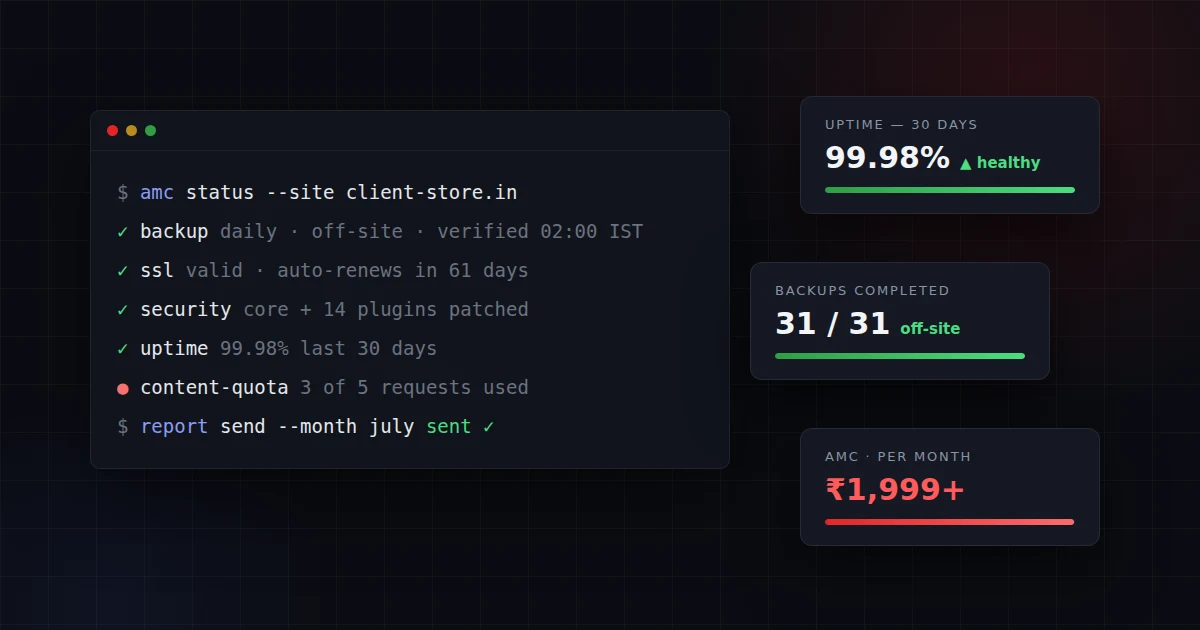
Most Indian agencies sell maintenance as an AMC — Annual Maintenance Contract: the same coverage billed yearly, usually at a discount over month-to-month. Multiplying the monthly bands above gives the realistic annual picture:
| Plan Level | Monthly | Annual (AMC) |
|---|---|---|
| Basic | ₹1,500–₹3,000 | ₹18,000–₹36,000 |
| Standard | ₹3,000–₹7,000 | ₹36,000–₹84,000 |
| Premium | ₹7,000–₹15,000 | ₹84,000–₹1,80,000 |
| Enterprise / Custom | ₹15,000+ | ₹1,80,000+ |
For reference, our own published care plans work out to ₹23,988/year (Basic Care), ₹59,988/year (Standard Care), and ₹1,55,988/year (Premium Care) at monthly rates, with a discount for annual billing. Full inclusions and quotas are on our website maintenance & AMC plans page. When comparing AMC quotes, check whether the yearly price includes hosting and domain renewal. That difference alone explains most of the gap between two otherwise similar quotes.
What Does Website Maintenance Cost by Platform (WordPress, React, Shopify)?
The technology your website is built on also affects maintenance costs:
WordPress Websites
WordPress powers 40%+ of websites globally, but its plugin ecosystem means frequent updates are critical. Monthly maintenance: ₹2,000–₹8,000. Key cost factors: number of plugins, theme customization level, and WooCommerce (if e-commerce).
Custom-Built Websites (React, Next.js)
Custom sites built with modern frameworks like React and Next.js typically need less frequent patching than WordPress but require developer expertise for updates. Monthly maintenance: ₹3,000–₹12,000. The higher floor reflects the specialized skill set needed.
E-commerce Websites
Online stores require the most intensive maintenance: payment gateway updates, inventory sync, order system monitoring, and security compliance. Monthly maintenance: ₹5,000–₹15,000+. Downtime directly costs you revenue, so higher SLAs are worth the investment.
What Happens If You Skip Maintenance?
The worst version is not a site that breaks, but a site nobody is watching. In our audit of 333 solar installers, 21% of the companies that owned a domain had let it lapse into a parking page or go dead entirely. If that is where you are heading, our guide to getting your website back when the developer has disappeared covers the recovery.
We've seen it repeatedly with businesses that approach us after neglecting their websites for 6–12 months:
- Security breach — outdated plugins are the #1 attack vector. A hacked site costs ₹20,000–₹50,000+ to clean up, plus lost business
- Google ranking drop — slow, broken, or insecure sites get penalized. Recovery takes months
- Lost customers — 88% of users won't return to a site after a bad experience
- Expensive rebuild — neglected sites often need a complete rebuild rather than repair, costing 3-5x more than ongoing maintenance would have
How to Choose the Right Maintenance Plan
Ask yourself these questions:
- How often does your content change? — If you update prices, products, or blog posts weekly, you need Standard or Premium
- Do you accept payments online? — E-commerce sites need Premium at minimum for security compliance
- What would 1 hour of downtime cost you? — If the answer is more than your monthly maintenance bill, invest in a higher tier
- Do you have technical staff? — If no one in-house can fix a broken form or update a plugin, you need a maintenance partner
Red flags when choosing a maintenance provider:
- No clear SLA or response time commitment
- No backup verification process
- "Unlimited changes" with no defined scope — this usually means slow turnaround
- No reporting or transparency on what was done each month
Website Maintenance vs Website Redesign: Which Do You Need?
Maintenance keeps your current site running well. But if your website is more than 3–4 years old, has a dated design, isn't mobile-responsive, or isn't generating leads, maintenance alone won't fix it, and you may need a website redesign.
Use our free website audit tool to check your current site health. If your score is below 50, a redesign may give you better ROI than ongoing maintenance of an underperforming site.
What Does Redpulse Software Include in Every Maintenance Plan?
At Redpulse Software, our maintenance packages include:
- Monthly maintenance report with screenshots of work completed
- Direct communication with the developer who maintains your site (no ticketing queues)
- Proactive monitoring — we catch issues before you notice them
- No long-term contracts — cancel anytime with 30 days notice
- Free consultation to determine which tier fits your needs
We maintain 50+ websites across Tamil Nadu and India, from single-page portfolios to high-traffic e-commerce stores. Contact us for a free maintenance audit of your current website.
According to Wordfence's annual security report, WordPress sites require regular security updates to prevent vulnerabilities.
Tools to check what your site needs
Before paying for maintenance, run these free audits to see exactly what's broken:
- Website SEO Audit — finds outdated meta tags, broken schema, slow pages.
- Website Ranking Checker — track if you're losing rankings (a sign maintenance is overdue).
- Website Traffic Checker — see if traffic is dropping — early warning for issues.
2026 update — what good website maintenance looks like
The Indian website-maintenance market has clarified its tiers in 2026 in ways worth knowing.
Security maintenance is no longer optional. WordPress and custom-PHP sites that used to skate by on quarterly patching now face routine compromise within 4–8 weeks of falling behind. The threat landscape has shifted toward automated bot-driven exploitation that targets unpatched plugins and themes within hours of vulnerability disclosure. A 2026 maintenance retainer that does not include weekly security review is incomplete.
Core Web Vitals have moved from advisory to ranking-critical. Sites that fail Largest Contentful Paint under 2.5 seconds, First Input Delay under 100ms, or Cumulative Layout Shift under 0.1 are visibly losing organic ranking compared to 12 months ago. Maintenance work that does not measure and defend Core Web Vitals is leaving rankings on the table.
AI-assisted maintenance has become a real tier. Some agencies now offer "AI-augmented maintenance" plans where routine tasks (content edits, image optimisation, plugin updates, basic SEO content) are handled with AI assistance at 30–40% lower cost than traditional retainers. The quality is decent for routine work; complex tasks still need human attention. Buyer caution: ask specifically what is AI-assisted and what is not.
What to ask before signing a 2026 maintenance retainer
Five questions every Indian SME should ask any agency quoting a maintenance retainer in 2026:
- What is your security-patching cadence and SLA for critical vulnerabilities?
- Do you measure and report Core Web Vitals monthly, with action plans for any regression?
- Who owns the hosting account, the domain, and the CMS admin — and what happens if I switch agencies?
- How many hours of content/development work are included monthly, and what is the rate for additional hours?
- What is your response SLA for site-down or hacked-site incidents?
Agencies that struggle to answer these questions confidently are the wrong agencies for 2026.
Budgeting a new site rather than maintaining one? Maintenance typically runs 15–20% of the build cost per year. See our complete website cost guide for India for the build-side numbers.
Need Help With Your Project?
Tell us what you're building — we'll send a detailed proposal with timeline and cost breakdown within 24 hours.
Frequently Asked Questions
What does annual website maintenance (AMC) cost in India?
How much does website maintenance cost in India per month?
What does a website maintenance contract typically include?
Can I maintain my website myself to save money?
How often should I update content on my Indian business website?
What happens if I do not maintain my website?
Is hosting included in website maintenance?
Sources & References
About the author
Ashok Kumar co-founded Redpulse Software in Karur, Tamil Nadu in 2010 with a single conviction: enterprise-grade software should not be a metro-only privilege. Sixteen years and 200+ projects later, that founding bet has held. Redpulse delivers the same engineering quality used by Bangalore and Chennai agencies, at Tier-2 operating cost, for businesses across India.
Ashok leads the company's business strategy, client relationships, and project management practice. He is hands-on across engagements. From the first 30-minute discovery call through the final launch readiness review, he is on every weekly client call. His technical depth is in digital marketing strategy and search optimisation. It also covers the operational discipline of running multi-channel growth programmes for Indian SMEs.
The clients Ashok has worked with span textile exporters in the Coimbatore-Tirupur belt and hospital networks across Tamil Nadu. The list also includes SaaS startups in Chennai's Tidel Park, retail chains, education institutions, and family-business manufacturers in Karur, Erode, and Salem. The pattern across all of them is the same. These are businesses that needed a real digital partner to take them from Excel-and-WhatsApp operations to digitally-instrumented growth. Not a freelancer, not a metro agency carrying metro overhead.
Outside the company, Ashok writes regularly on the Redpulse blog about practical digital marketing for Indian SMEs. His focus is transparent pricing, attribution measurement, and what actually works for businesses operating outside the venture-funded startup bubble.
Free Consultation
Get expert advice for your project