Part ofIndia IT Cost·Pricing guides for IT services in India — websites, mobile apps, e-commerce, custom software, and GST billing systems.
Your website went live, everyone shared the link, and then a quieter question showed up: who keeps it running from here?
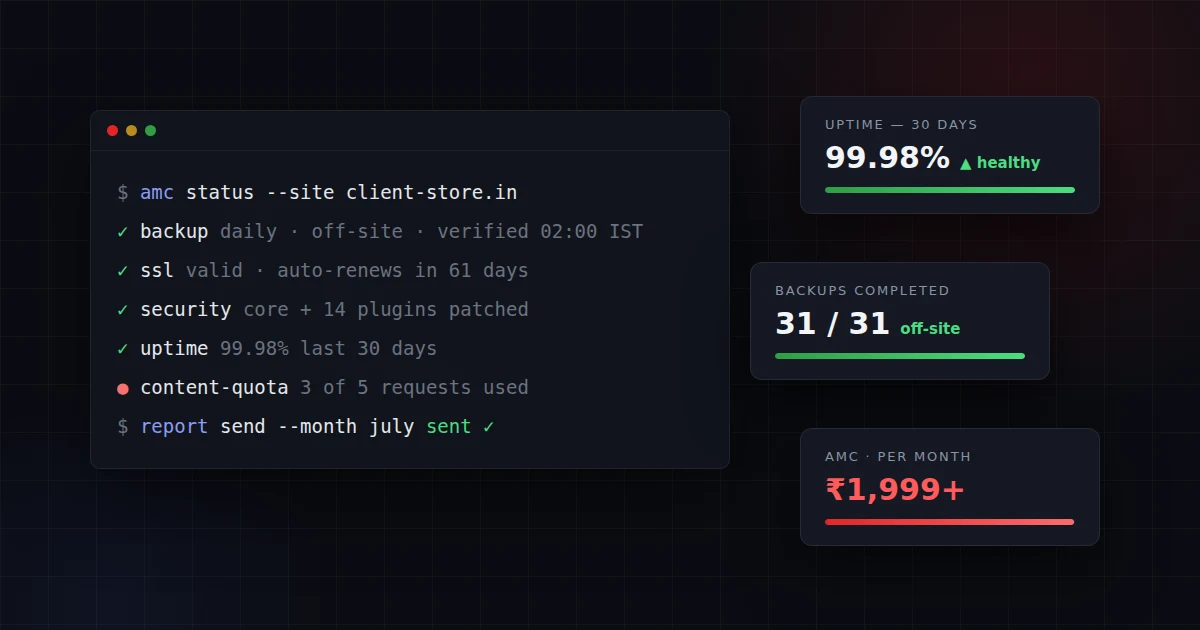
That's the job of a website AMC. A website AMC (Annual Maintenance Contract) is a fixed-fee agreement — typically ₹1,500–₹15,000 per month in India, or ₹18,000–₹1,80,000 per year — under which an agency keeps your site backed up, secure, updated, monitored, and supported, with a set quota of content changes included.
This guide breaks down exactly what a good AMC package includes, what each tier costs in 2026, what's deliberately not included, and how to compare providers without getting burned.
Need Help With Your Project?
Tell us what you're building — we'll send a detailed proposal with timeline and cost breakdown within 24 hours.
What is a website AMC, exactly?
An AMC turns website upkeep from "call someone when it breaks" into a standing service with defined deliverables. Instead of hunting for a developer at midnight when your contact form dies, you have a team already holding your access keys, your backups, and your history.
The "annual" in the name refers to the contract term, not the billing. Most Indian agencies bill AMCs monthly; some offer a discount if you pay the year upfront.
One distinction trips people up constantly: an AMC is not hosting. Hosting is rent for the server. The AMC is the caretaker who keeps the house standing. Ask any provider whether hosting charges are inside or outside the quoted price — it changes comparisons completely.
What's included in a website maintenance package?
A serious AMC covers seven things. If a quote is missing more than one of these, you're looking at a hosting reseller, not a maintenance service.
| Inclusion | What it actually means |
|---|---|
| Backups | Scheduled copies of your site and database, stored off the hosting server, restorable on request |
| Security updates | CMS core, theme, and plugin patches (critical for WordPress — OWASP's top web risks mostly exploit outdated software) |
| Uptime monitoring | Automated checks that alert the team when your site goes down — before your customers tell you |
| SSL management | Certificate renewal so browsers never flash "Not Secure" at your visitors |
| Content changes | A monthly quota of text/image updates — new prices, new team member, updated timings |
| Support channel | A defined way to reach a human, with a stated response time |
| Monthly report | Proof of all of the above: uptime %, backups completed, changes made |
The report is the part most owners undervalue when comparing quotes — and the first thing they appreciate after a month. It's the difference between paying for maintenance and seeing maintenance.
Need Help With Your Project?
Tell us what you're building — we'll send a detailed proposal with timeline and cost breakdown within 24 hours.
We see the same pattern every few months: a business reaches us after their site has been down or defaced, only to discover their previous provider kept no backups worth restoring. The cleanup and rebuild typically runs ₹20,000–₹50,000 — more than several years of a proper AMC would have cost. The report and the tested backup are what you're actually buying.
How much do website AMC packages cost in India?
Market-wide, small business sites in India pay in these bands (consistent with our full maintenance cost breakdown):
| Site type | Typical monthly | Typical annual |
|---|---|---|
| Static / brochure site (5–10 pages) | ₹1,500 – ₹2,500 | ₹18,000 – ₹30,000 |
| Business site with CMS / blog | ₹2,000 – ₹5,000 | ₹24,000 – ₹60,000 |
| E-commerce / large site | ₹7,000 – ₹15,000+ | ₹84,000 – ₹1,80,000+ |
For reference, our own published Care Plans at Redpulse run ₹1,999 (Basic), ₹4,999 (Standard), and ₹12,999 (Premium) per month — that's 2 content update requests a month on Basic, 5 requests plus one new page on Standard, and 12 requests (fair use) plus two new pages on Premium. The website maintenance service page lists the full inclusions per tier.
Why the huge range across the market? Three drivers: platform (WordPress needs monthly patching; well-built static sites barely change), quota (how many content changes are included), and response time (same-day support costs more than 48-hour support — someone has to be available).
Monthly vs annual contracts — which should you choose?
Pay monthly when you're testing a new provider. Pay annually when they've earned it.
That's the honest version. Annual prepayment usually earns a discount and locks your price, but it also locks you — and you don't know a maintenance provider's true quality until you've seen a real problem handled. A reasonable path: three months monthly, then switch to annual if the reports keep arriving and the fixes keep landing.
One thing annual billing genuinely helps with: SSL certificates and domain renewals sneak up yearly. Bundling them into an AMC means they simply never expire. (Let's Encrypt certificates renew every 90 days — automated in any competent setup, a recurring outage risk without one.)
What's NOT included — read this before signing anything
Every AMC dispute we've ever seen comes from this list not being written down:
- Redesigns — "refresh the whole homepage look" is a project, not a content change
- New features — payment gateways, booking systems, portals: quoted separately
- Content writing — an AMC updates the text you send; writing blog posts and copy is content marketing, a different service
- New pages beyond quota — most tiers include zero or a small number per month
- Third-party damage — fixing what another vendor (or a client-side edit) broke is usually billable
A provider who lists exclusions upfront is protecting both sides. A provider who says "unlimited everything" at ₹999/month is telling you they don't intend to answer your calls in month three. It's why our own Premium tier says 12 requests a month with fair use instead of "unlimited" — a number we can honour is worth more than a promise nobody can.
How to choose the right AMC package: 5 questions
Ask these before you sign, in this order:
- "Where are backups stored, and when did you last restore one?" — off-server storage and a real restore test separate professionals from resellers
- "What exactly counts as one content change?" — get the definition in writing
- "What's the response time, on which channel?" — "we're always available" is not a number
- "Is hosting included or billed separately?" — makes or breaks every price comparison
- "What does the monthly report show?" — if there's no report, you'll never know what you paid for
If a provider answers all five without flinching, the price is probably fair — whichever tier you land on.
Red flags when comparing providers
One red flag sits above all the others: a provider who will not give you the domain and hosting logins in your own name. If that relationship ends badly you are left recovering your own website from a developer who has stopped replying, which is a far more expensive problem than any AMC.
Watch for these while collecting quotes: no written exclusions list. No mention of backups (or backups "included" on the same server as the site). Unlimited-everything pricing that's cheaper than one hour of developer time. No report, no dashboard, no proof — "trust us, we're maintaining it." And a personal favourite: quotes that won't say whether Google-facing basics like page experience and Core Web Vitals monitoring are anyone's responsibility.
None of these are automatic scams. All of them are questions you should ask in writing.
The bottom line
A website AMC package in India costs ₹1,500–₹15,000 per month depending on platform, quota, and response time — and the inclusion list matters far more than the headline price. Know what's covered, get the exclusions written down, and demand the monthly report.
Want a number for your specific site? Our website maintenance cost calculator gives you an instant estimate based on your platform and page count — free, two minutes, no signup.
Need Help With Your Project?
Tell us what you're building — we'll send a detailed proposal with timeline and cost breakdown within 24 hours.
Frequently Asked Questions
How much does a website AMC cost per month in India?
Is an AMC necessary for a static website?
What is the difference between an AMC and web hosting?
Can I maintain my website myself instead of paying for an AMC?
What happens if I skip website maintenance completely?
Sources & References
About the author
Ashok Kumar co-founded Redpulse Software in Karur, Tamil Nadu in 2010 with a single conviction: enterprise-grade software should not be a metro-only privilege. Sixteen years and 200+ projects later, that founding bet has held. Redpulse delivers the same engineering quality used by Bangalore and Chennai agencies, at Tier-2 operating cost, for businesses across India.
Ashok leads the company's business strategy, client relationships, and project management practice. He is hands-on across engagements. From the first 30-minute discovery call through the final launch readiness review, he is on every weekly client call. His technical depth is in digital marketing strategy and search optimisation. It also covers the operational discipline of running multi-channel growth programmes for Indian SMEs.
The clients Ashok has worked with span textile exporters in the Coimbatore-Tirupur belt and hospital networks across Tamil Nadu. The list also includes SaaS startups in Chennai's Tidel Park, retail chains, education institutions, and family-business manufacturers in Karur, Erode, and Salem. The pattern across all of them is the same. These are businesses that needed a real digital partner to take them from Excel-and-WhatsApp operations to digitally-instrumented growth. Not a freelancer, not a metro agency carrying metro overhead.
Outside the company, Ashok writes regularly on the Redpulse blog about practical digital marketing for Indian SMEs. His focus is transparent pricing, attribution measurement, and what actually works for businesses operating outside the venture-funded startup bubble.
Free Consultation
Get expert advice for your project